Childrens Court Queensland
What is the Childrens Court and how does it work?
What Courts do Young People under 18 go to?
In Queensland if you are under 18 and the police charge you with an offence you will always go to a Childrens Court first. For some types of offences (called indictable offences) a defendant can choose a higher level court with a Judge to deal with it. Sometimes the Magistrate can decide the case must go to a higher court even if the young person does not choose this.
If the indictable offence is a ‘serious’ offence under the Youth Justice Act or the person wants their case to go to the higher court to be decided, the Magistrate has to look at the police evidence to decide if the evidence is good enough for the case to go the higher court. After listening to the witnesses the Magistrate might decide there is not enough evidence and that is the end of the case.
If a young person is found guilty or pleads guilty, a Magistrate will sometimes decide they cannot give the young person a serious enough sentence and they will send it to the higher court which has more power.
Childrens Court of Queensland (CCQ)
If adult cases go to a higher court they go to either the District Court or if the matter is very serious, like murder or drug matters such as trafficking, to the Supreme Court. If a young person’s case is sent to a higher court, it is usually sent to the Childrens Court of Queensland (CCQ) with a special Judge from the District Court. Matters involving young people can only be heard in the adult District Court or Supreme Court of Queensland if:
- the child is charged after they turn 18
- the Magistrate has sent the case to the District Court because of special circumstances, for example, if a child is charged with committing the offence with an adult
- the matter is very serious and has to be sent to the Supreme Court.
If you plead not guilty in the CCQ you can choose to have a jury (a group of 12 people) listen to the witnesses and decide if you broke the law or you can choose to have the Judge do this. If you are in the District or Supreme Court and plead not guilty, then a jury has to decide whether you broke the law.
If you plead or are found guilty in any of these courts, the Judge decides what sentence you get.
The CCQ, District Court and Supreme Court in Brisbane are in the large courts complex in George Street in Brisbane, near the Roma Street train station. There are many Court Rooms and Judges in the complex. There are no duty lawyers in the CCQ, District or Supreme Courts. If you have to go to one of these courts it is important you see a lawyer beforehand.
Who will be in the Court Room?
The Judge will have an assistant who reads out the charge and there are also bailiffs who help the court, for example by passing around exhibits. No one is allowed to publish information identifying the person who is charged.
District or Supreme Courts are open to the public so anyone can come in (eg groups of school students looking at how the courts work).
What to do in Court?
If you have to go to court, either because you have been charged with an offence or because you are a victim of crime or a witness, you should act respectfully.
- Make sure your phone is turned off while you are in court
- You should dress appropriately (no thongs or bare mid-riffs)
- Remove your cap if you are wearing one
- You should not laugh or giggle (even if you are nervous)
- Answer questions respectfully – do not swear
- Pay attention to what is being said
- Look at the person when answering their questions
- The Judge is called ‘Your Honour’ (always be respectful when speaking to them).
If you treat the process seriously you will give yourself the best chance of being listened to. People in court need to focus on listening to what you are saying, not looking at what you are wearing. If you disrespect the court you can be charged with another offence.
How long will I have to be at court?
Most courts start at 9am but you should check your paperwork and ask your lawyer about start times. If you do not have a lawyer you should get to court early (8.30am) so that you can find the court room and be ready when your name is called. If you are running late, call your lawyer or the court and let them know.
Usually the court will have a lot of matters to get through on the one day so you may have to wait for your turn. Sometimes this can take a few hours so make sure you bring something suitable to do as well as something to eat.
The bailiff will come outside the courtroom to the waiting area and call your name when it is your turn. If you are not there when your name is called (even if you were there at the start and later left) the Magistrate or Judge may order the police to find you and bring you to the court (issue a warrant for your arrest).
If you have been charged with an offence you need to be in the courtroom the whole time your matter is being discussed with the Judge. If you are a witness you will be able to leave the court building once you have finished giving your evidence. Witnesses cannot be in the courtroom while other witnesses are giving their evidence.
Courts normally break for lunch at 1pm for about an hour and sometimes will have a break for morning and/or afternoon tea. Courts usually finish no later than 5pm. If your matter is not finished you may need to come back the next day. There is no set time limit for how long a court matter can take.
Where is the Childrens Court?
The Brisbane Childrens Court is located at Court 38 or Court 39, Level 8, 363 George Street, Brisbane Q 4000
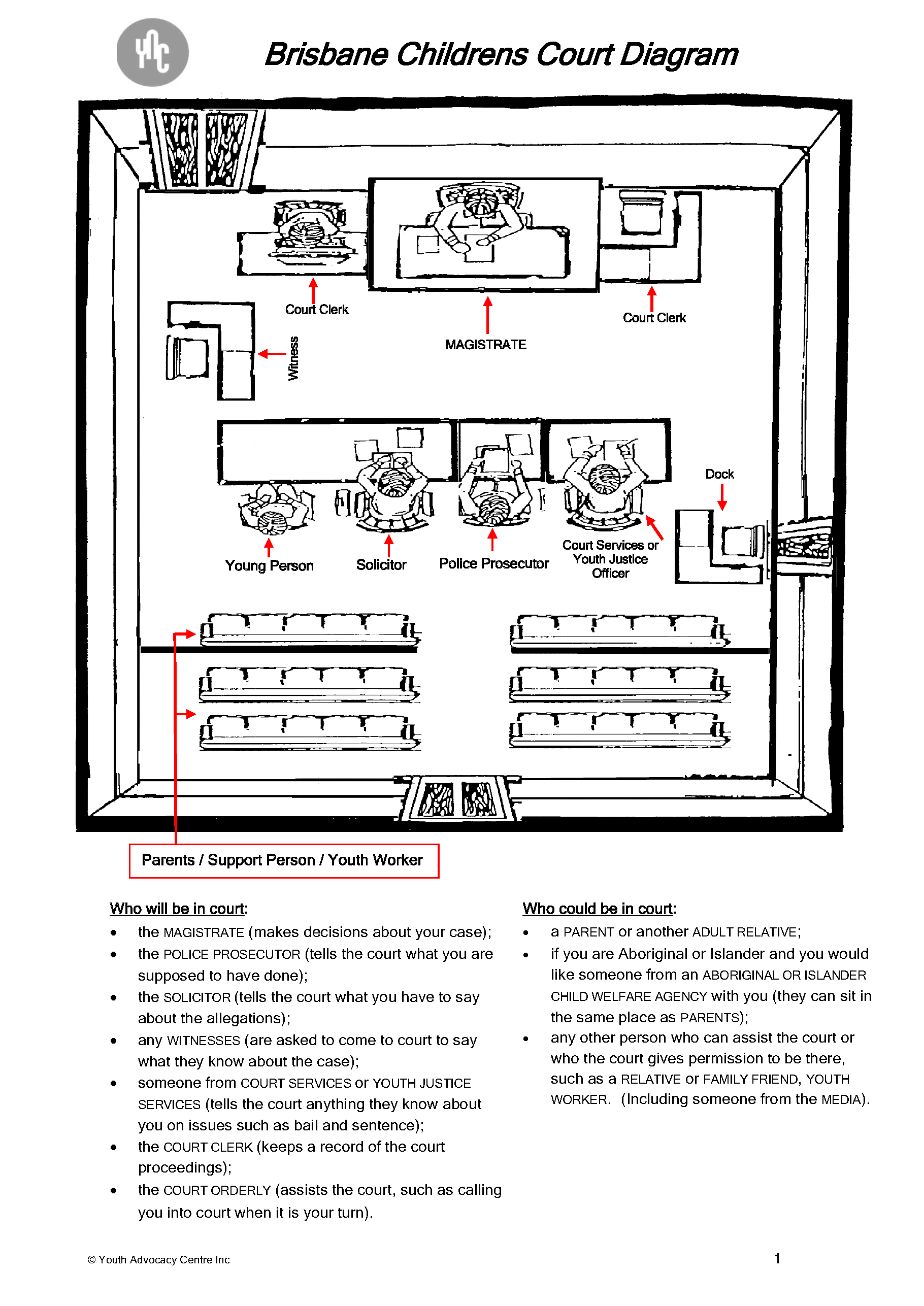
Click on the link below to print or view a copy of the Childrens Court Diagram and information about appearing in court.
Who can help?
Youth Advocacy Centre (YAC) www.yac.net.au ………………………….. 3356 1002
Hub Community Legal www.communitylegal.org.au……………………. 3372 7677
YFS Legal www.yfs.org.au…………………………………………………. 3826 1500
Legal Aid Queensland www.legalaid.qld.gov.au……………………….. 1300 651 188
Aboriginal & Torres Strait Islander Legal Service www.atsils.org.au……. 3025 3888 or (free call) 1800 012 255 (24hrs 7 days a week)
Translating & Interpreting Services (24hrs)………………………………. 131 450
Youth Legal Advice Hotline ……………………………………………….. 1800 527 527
Community Legal Centres (CLCs) see www.naclc.org.au for your nearest CLC
Browse other legal topics
This sheet is intended to provide general legal information about the law in Queensland. This information is not legal advice. If you have a particular legal problem you should contact a solicitor for legal advice. Below is a list of agencies that might be able to assist you, including legal agencies.
This sheet was last reviewed and updated in June 2023. The Youth Advocacy Centre does not accept responsibility for any action or outcome because of anyone relying on the information provided.
Follow Us
Follow us on social media for information on laws, youth rights, and news.
Contact YAC
Street address: Level 4, 16 Peel Street, South Brisbane Q 4101
Mailing address: Level 4, 16 Peel Street, South Brisbane Q 4101
Tel: (07) 3356 1002
Bussiness hours: 9am - 5pm, Mon - Fri
If you need urgent assistance outside of these hours:
- Youth Legal Advice Hotline 1800 527 527 (Mon to Thurs 8am - 9pm, Friday 8am to Sunday 5pm)
- Kids Helpline 1800 551 800 (24/7, 365 days per year)
- Lifeline 13 11 14 (24/7, 365 days per year)
- Homelessness Hotline 1800 474 753 (24/7, 365 days per year)
- If you are over 18, and seeking access to Mental Health Services in Queensland, Acute Care Team on 1300 MHCALL (1300 64 2255).